
The flag that now flies over every school in Ireland began as a gift of French silk, handed to a young Waterford rebel by revolutionaries who had just toppled their king. Meagher told the Irish people the white band stood for a lasting truce between the orange and the green, a hope he offered while facing a treason charge that would see him banished to Van Diemen's Land.The Irish flag - or, in Irish, the 'Bratach na hÉireann' – was flown publicly for the first time on March 7, 1848, during that year's Young Irelander Rebellion in Waterford City at the Wolfe Tone Confederate Club.
The Irish flag, or tricolor, was first flown by Thomas Francis Meagher, then a leader of the Young Irelander movement, who would go down in history as Brigadier General Thomas Francis Meagher of the Union Army during the American Civil War.
In the US, Meagher is best remembered for his role as a General in the Union Army and the governor of what is now Montana. His impact on Irish history and patriotic pride was also immense.
When Meagher hung the tricolor in Waterford, it boldly flew for eight days and nights until the British took it down.
The 1848 revolutions across Europe had inspired Meagher and his fellow Young Irelanders. In April of 1848, a contingent of them traveled to France to congratulate the rebels there on overthrowing King Louis Philippe I. There, Meagher was presented with an Irish tricolor woven out of French silk.
Upon returning to Ireland, he, in turn, presented it to the Irish people, explaining the symbolism of the flag’s three colors: “The white in the center signifies a lasting truce between the orange and the green,” he said, “and I trust that beneath its folds the hands of the Irish Protestant and the Irish Catholic may be clasped, in generous and heroic brotherhood.”
The green represents Irish nationalism; the orange, Ireland’s Protestant minority and the Orange Order; the white, lasting peace between the two.
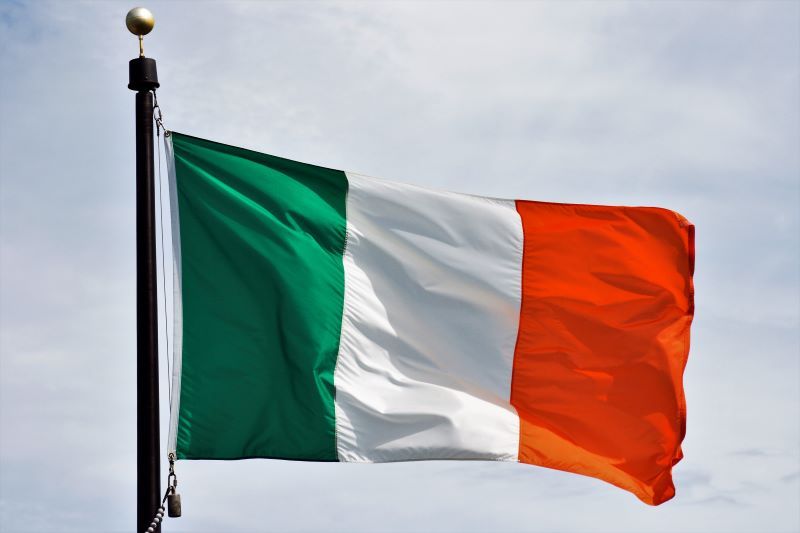

Ireland's tricolor (Getty Images)
For his role in the 1848 rebellion, Meagher was tried for treason and sentenced to death, but this sentence was commuted to banishment to Van Diemen’s Land in Australia. He would later escape to a new life in the United States.
While the tricolor had gained traction as a symbol of Ireland until the 1916 Easter Rising, the primary flag of Ireland was green with a harp in the center (the harp remains Ireland’s national symbol; Ireland is the only country in the world with a musical instrument as its national symbol). That flag was used as early as 1642 by Owen Roe O’Neill, an Irish soldier and leader of the O’Neill dynasty.
During the Rising, both flags were flown above the GPO, the rebels' headquarters, and the tricolor became more widely accepted.
After the Rising, it was adopted by the IRA during the Irish War of Independence (1919 – 1921), was a symbol of the Irish Free State from 1922 – 1937, and then, when the Irish constitution came into law later that year, it was confirmed as the official flag of Ireland by Article 7, which reads: “The national flag of Ireland is the tricolor of green, white and orange.”
Today, the tricolor is a symbol of Irish pride and remains an essential reminder of the peace achieved and the progress yet to be made.
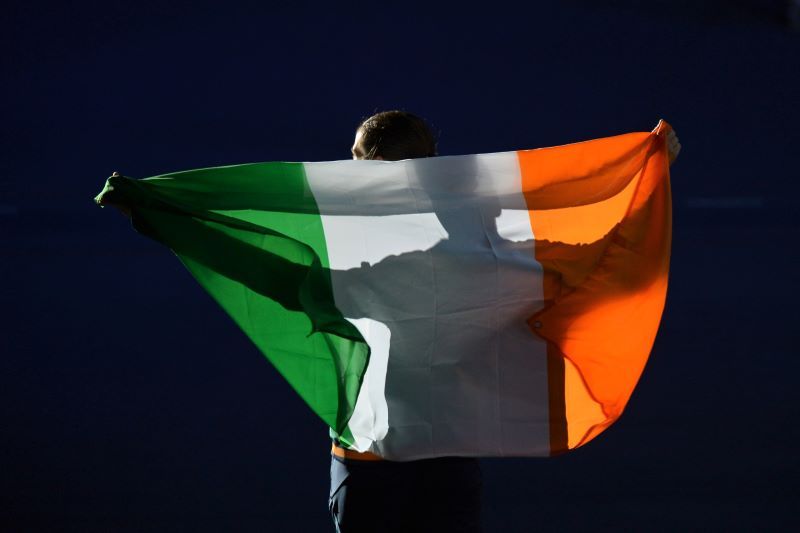
Katie Taylor with the Irish flag at the 2012 Olympics (Getty Images)
Throughout 1916, which, in addition to marking the centenary of the 1916 Easter Rising, also marks 100 years since the tricolor emerged into the popular imagination, the Irish Defense Forces and the Thomas F. Meagher Foundation are working to ensure that the history of the flag is better known.
In the lead-up to the 1916 centenary, every school in Ireland received an Irish flag. In post-primary schools, the Thomas F. Meagher Foundation presented the Irish flag. In primary schools, the flag was given by a member of Ireland’s defense forces, who educated students on the flag’s history, meaning, and proper care.
For example, the flag must always be flown above any others on the staff, it must never be displayed in poor condition, and it must always fly with the green segment closest to the flagstaff. (Reversed, the Irish flag is quite similar to the Ivory Coast flag.)
To learn more about the Thomas F. Meagher Foundation, visit their website.
* Originally published in Aug 2016, updated in Oct 2026..

Comments